From 900mg of Gabapentin to None
A woman in her late 40s came in with five years of left-arm nerve pain and numbness. After one NRT session, her arm felt markedly better. Over the next several years she tapered gabapentin from 900 mg a day to zero, and she has now been off pain medication for nearly a year.
This is one person's experience in ongoing care. It is not a promise of the same result.
At a glance
Main complaint: left-arm nerve pain and numbness, especially the thumb and index finger
How long she had it: about 5 years before the first visit
What had not helped: deep-tissue massage that put her out for 2 weeks with no improvement; light Swedish massage that felt fine but did not change her symptoms; morphine 15 mg that barely touched the original pain
First change: after 1 NRT treatment (December 2, 2020)
Her words at the second visit: “L arm felt so good after the last tx”
Medication at the start: gabapentin 900 mg/day for nerve pain
Off gabapentin: September 2025 — about 4 years and 9 months after the first visit
Update, August 2026: still off medication. Remaining complaint is tension between the shoulder blades and in the upper neck
Background
Imaging and prior findings included a C3/C4 disc protrusion, upper-cervical facet arthropathy, left C6 nerve involvement, degenerative changes at C5–C6 and C6–C7, left supraspinatus tendinopathy, and a history of left adhesive capsulitis. She had also been in a motor-vehicle collision as a teenager.
The arm symptoms began around 2015, possibly after a cable/chest workout. Early on, the pain was severe enough that morphine 15 mg barely relieved it. Over time the sharp pain eased and numbness became the main problem: dull sensation in the thumb and along the forearm, with nerve-type symptoms into the first and second digits.
Before we met — well after the original injury — she had a deep-tissue massage with another RMT. It put her out for 2 weeks and produced no improvement. Light Swedish massage felt fine, but it failed to help her symptoms at all.
First visit and first change
The first NRT session was December 2, 2020.
Thirteen days later, at the second visit, she reported that her left arm “felt so good after the last tx.” Sensation testing was already shifting. By mid-January 2021 the forearm and the first two digits felt better, she could feel the work in her neck after treatment, and a run produced much less aggravation than usual.
That is the part worth sitting with: the first noticeable change came after a single NRT treatment, in a body that had already lived with these symptoms for about five years, and after deeper and lighter massage had not moved the needle.
What we kept working on
The through-line over the years was left-arm and hand nerve symptoms (thumb and index finger especially), left-shoulder discomfort, and a stubborn “knot” between the shoulder blades that would flare if it was not treated thoroughly. Other complaints came and went with life: sciatica, foot cramps, neck stiffness with sleep and rotation, and later some overuse from work and new training.
The picture was not a straight line. There were quieter stretches and there were flares after moving house, shoveling snow, COVID, a fall, and a return to demanding upper-body activity. The overall direction was still the same: more sensation returning, fewer nerve symptoms, and less need for pain medication.
A notable midpoint: by February 2022, sensation was returning in the left biceps and forearm after about five years of loss.
Function followed. She went back to running without the same arm flare. She moved a queen mattress on her own. Eventually she took up pole dancing — hard upper-body work that would have been unthinkable in the years when numbness and nerve pain were the daily baseline.
Gabapentin: the taper
She made medication decisions with her prescribing physician. What follows is simply what she reported in clinic over time.
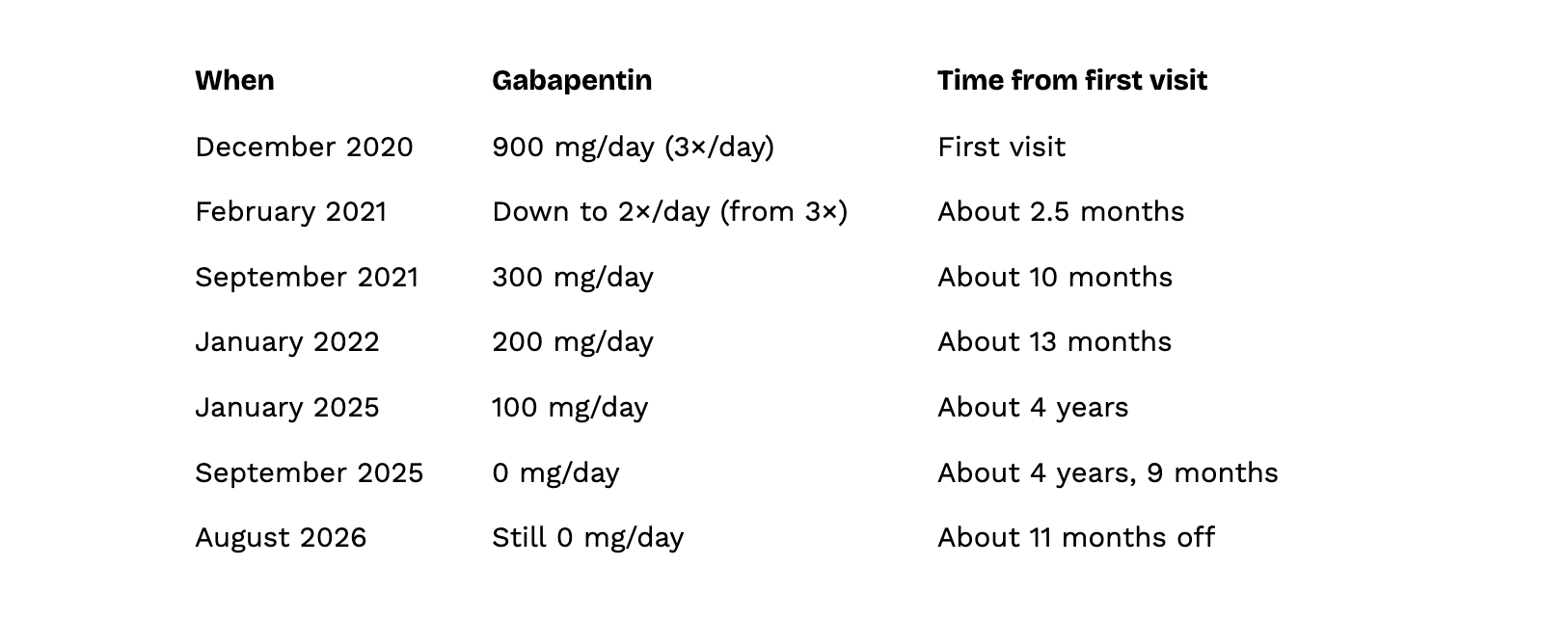
By June 2023 she was reporting no headaches or migraines and no arm pain or numbness between visits. In August 2022 she accidentally went a day or two without gabapentin, did surprisingly well, and only needed half her usual dose afterward. Those were early signs that the nervous system was no longer leaning on the same amount of medication.
It still took until September 2025 — just under five years of care — before she fully stopped gabapentin because the pain no longer required it. As of August 15, 2026, she remains off that medication.
Where she is now
Nearly six years after the first visit, she is still off gabapentin. The remaining complaint is ordinary tension between the shoulder blades and in the upper neck — maintenance territory, not the nerve pain and numbness that brought her in.
A note for readers
NRT is a gentle manual approach that works with restriction, tissue tension, and how the body is holding itself. Individual results vary. This case is shared with identifying details removed. It is not medical advice, and it is not a claim that NRT replaces prescribed medication.
Curious to explore NRT further?
Learn about upcoming NRT workshops for practitioners, or book a treatment with Jonas to experience the approach firsthand.
These case studies reflect individual patient experiences and outcomes. Results vary by patient and are not a guarantee of similar results for any other individual.